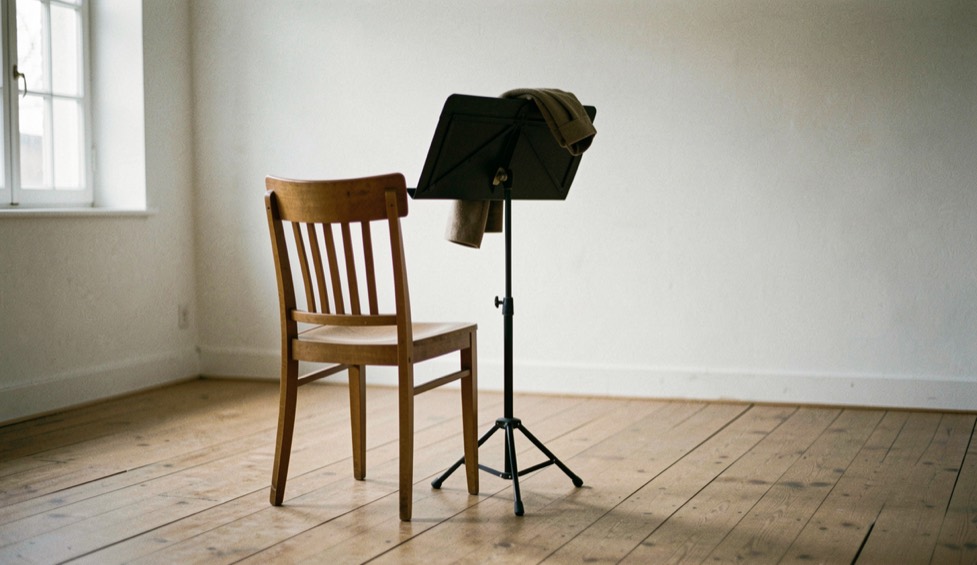
A melodica is a reed organ small enough to hold and loud enough for forty chairs, and its note is the most obedient in the room: it starts when your air starts and stops when your air stops. That obedience moves the work of the set from the fingers to the lungs, because every swell and every chord becomes a breath decision. What the room contributes after the air stops is only the tail it already owns.
A reed organ held in two hands
The Melodica name belonged to the Hohner company, which brought out a series of these instruments in the 1950s; other makers sell the same kind of instrument under other names, so the desk writes about the family, not the brand. Physically it is a small hand-held reed organ powered by breath: air goes in through a mouthpiece fitted into a hole in the side, and a keyboard on top, usually two or three octaves and commonly 32 or 37 keys though the family runs from 13 to 45, opens a valve over each key's reed. Some carry two rows of buttons instead. In a two-bag rig it asks the least space and the most lung, a fair trade for a writer playing alone; see instruments that fit in two bags.
Why does a note with no decay behave differently?
Pluck a string and it releases its energy whether or not you stay with it: the attack is one event and the fade belongs to the instrument. A melodica reed has no fade of its own. Keep the air moving and the note continues; stop the air and the note is gone, entire, before your mouth has left the mouthpiece. So the silence after a chord is absolute: nothing rings on, and the only thing left in the room is the room's own tail. In the dry back rooms this desk writes about that tail is short, which makes the ending of each chord as exposed as its beginning. The family's early history, trade name and all, is set out in Pat Missin's family history; the modern form is credited to the 1950s.
The air budget of a held chord
Volume on this instrument follows air pressure, and the air is a budget rather than a tap. A crescendo is a lung decision: more pressure, more level, and a cost you feel four bars later. Several keys can sound at once, limited only by the air available; read every multi-note idea against that clause. The desk's own accounting, in words rather than decibels:
| What is held | What the breath does | What the room hears |
|---|---|---|
| One note | Cheap; pressure can rise without borrowing from anything | The loudest, steadiest line the instrument owns |
| Three notes | A third of the air each; pressure holds if you plan the length | A chord with weight, still able to swell |
| Five notes | A fifth of the air each; the level thins as the chord widens | A pad that fades first at the top and costs the most to sustain |
A five-note chord at the same breath is quieter per note than a single note; the accounting is the desk's own, redoable against one held breath.
Where should the chair go under a low ceiling?
The instrument puts one sound on the record that a guitar does not: the breath itself, audible at the front row in a room whose floor sits between 20 and 30 dB. Whether that is a flaw or a texture is your decision, and the chair helps you make it. Sit close and the breath reads as part of the performance, the way a singer's intake does; sit back and it sinks under the keys. The ceiling has an opinion too. Under a 2.4 m ceiling the first reflection arrives about 1.7 ms after the direct sound and about 1.5 dB below it, so each attack reaches the front row twice, almost together, and the dryness this desk traced in what a low ceiling does to a ballad presses harder on a reed attack than on a sung phrase, the attack being the note's loudest moment. In a tall room the tail hides the breath noise; in a low one, nothing does.
Five things to try in the empty room
Ten minutes in the empty room, before the chairs fill:
- Hold one note at the pressure you would use for a last verse, stop it sharply, and count what the room still holds.
- Play the same held chord from the stage position and again from the back row, and find which seat hears more breath than reed.
- Stand under the lowest part of the ceiling and play a short attack, then step two metres to the side and repeat it.
- Sustain a five-note chord as long as is comfortable and notice where the top gives out first.
- End a song on a single stopped note rather than a let-down, and let the room's own tail finish the phrase.
Sources
- Pat Missin, A Brief History of Mouth-Blown Free Reed Instruments: Melodica Family, the melodica family pages, page dated 2002 to 2004, consulted 5 September 2026.
- Wikipedia, article "Melodica", the melodica entry, consulted 5 September 2026.
- The Small Rooms desk, what a low ceiling does, on this site, consulted 5 September 2026.
- The chord accounting is the desk's own arithmetic, redoable from the assumptions above.