A twenty minute slot holds four songs comfortably, five only if they run near three minutes, and six never once the talking is counted. The count is arithmetic, and it can be done at a kitchen table before the night. The three terms are a walk, a song and a gap, and everything below follows from them.
The arithmetic has three terms
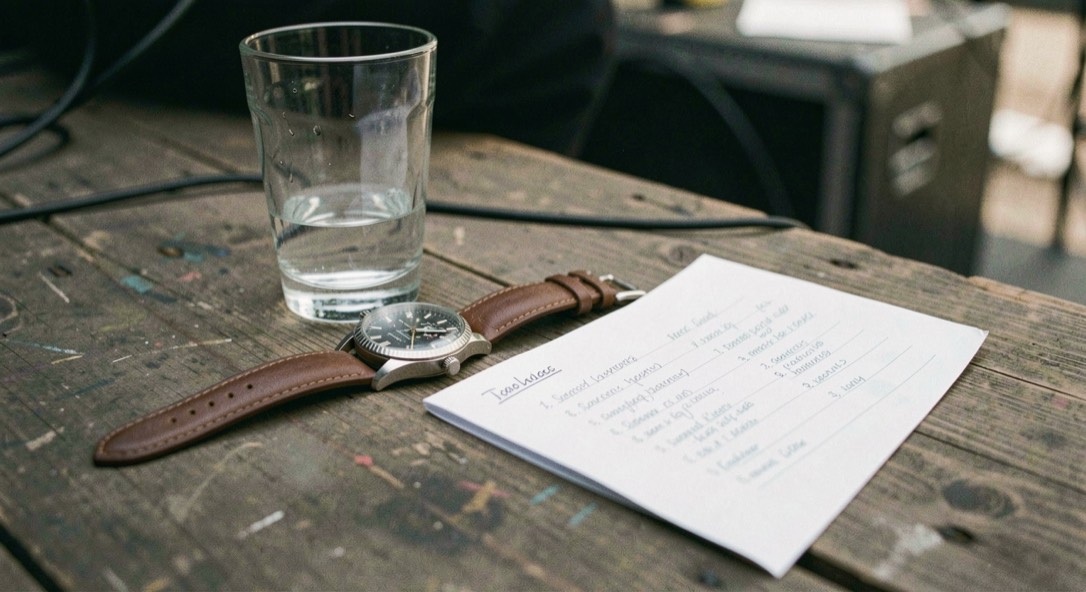
The document behind the count is plain: a list, handwritten or printed, setting out the songs and the between-song material in the order it is meant to arrive. The Wikipedia entry on set lists records two uses. Performers build it to move between tone, tempo and dynamics, giving the set a range the listener remembers, and they adapt it to the audience and the place. The page also notes the horizontal line near the bottom of a printed list, which marks where the encore begins.
A twenty minute slot rewrites that document. The slot is fixed by whoever runs the night, so the encore line has nothing to mark; a set whose length somebody else decided has no encore. One question is left: how many songs, with everything between them, fit inside 1200 seconds. The order of the set is a separate question, treated in its own note.
The model has three terms. The walk is the time from being announced to the first note: crossing, sitting, plugging nothing in, one breath; the desk allows sixty seconds. The song is the average length of the songs as played, not as recorded. The gap is tuning plus talk between two songs; thirty seconds covers a tuning check and one sentence. The total is the walk, plus the number of songs times their average, plus one gap fewer than there are songs.
Four songs, or five short ones
Hold the walk at sixty seconds and the gap at thirty, and the average song decides the count. Songs at three minutes: five come to 1080 seconds, eighteen minutes, and a sixth takes the total to 21:30. Songs at three and a half: four come to 990 seconds, and a fifth lands on 20:30, half a minute over. Songs at four minutes: four again, 1110 seconds.
| Average song | Songs that fit | Time used | Spare |
|---|---|---|---|
| 3:00 | 5 | 18:00 | 2:00 |
| 3:30 | 4 | 16:30 | 3:30 |
| 4:00 | 4 | 18:30 | 1:30 |
The spare column is the honest one. Those minutes are not room for another song; they are room for what never gets timed, a slow breath, a thank you, a last chord allowed to finish. Whether a chord finishes is partly the room's decision; how the ceiling changes a ballad is the desk's note on that.
What does a minute of talk cost?
At an average of three minutes, one minute of talking is a third of a song. That is the exchange rate, and it is severe at this scale: a two minute story before the last song is a whole short song not played. The room hears the story, and never the song it replaced. Talking is not waste, and a small room is exactly where a sentence between songs lands; it has to be budgeted like the music. A performer who plans five three minute songs and four one minute stories has planned 900 seconds of songs, 120 of ordinary gaps, 60 of walk and 240 of story, which is 1320 seconds, twenty two minutes, in a slot that holds 1200. The arithmetic does not care which promise is broken, only that one is.
What happens when a song is cut on the night?
Sets are cut live: a reed chokes, a string goes, the room is wrong for one song, or the slot shrinks on the instruction of whoever runs it. Cutting one song returns its length plus one gap; at the assumptions above, three and a half minutes. It is the only honest way to buy time mid-set: playing faster changes the songs themselves, and skipping the tuning is a loan against the next one. The same arithmetic settles who pays when nothing is cut. A set that runs over does not bill the audience; every minute over is taken from the next act's slot or from the house's closing time. The overrun belongs to the people running the room and to the act after yours, which is why the desk treats the slot as a wall, not a suggestion.
Five timings to take at home
A phone stopwatch and one quiet hour settle more than any estimate. Time these exactly as they would happen on the night:
- The walk, from your name being said to the first note: crossing, sitting, one breath.
- Each song as played, from its first note to the ending you actually use.
- The tuning check you really do between two songs, hands off and hands back on.
- The one sentence you say between songs, spoken aloud at speaking pace.
- The story before the last song, if you tell one, first word to last.
Sources
- Wikipedia, article "Set list", en.wikipedia.org/wiki/Set_list, consulted 5 September 2026.
- The worked examples are the desk's own arithmetic, redoable from the assumptions above.